Finding the right water filter pitcher can instantly upgrade your daily hydration without plumbing, drilling, or expensive under-sink installations. For many US homes, a reliable pitcher is the easiest and most budget-friendly way to cut chlorine taste, reduce lead, and make tap water taste better.
In this guide, we compare the top 3 water filter pitchers for 2026 based on what they actually remove, how long filters last, and how easy they are to live with every day.
This article contains Amazon affiliate links. As an Amazon Associate, we earn from qualifying purchases, at no extra cost to you. It doesn’t affect which products we recommend.
Quick Picks
Best overall, lowest maintenance: Brita Large 10-Cup with Elite Filter
Best for maximum purity: ZeroWater 10-Cup Ready-Pour
Best value for lead reduction: PUR 11-Cup with PUR Plus Filter
| Pitcher | Best For | Capacity | Filter Life | Price |
|---|---|---|---|---|
| Brita Large 10-Cup Elite | Low maintenance | 10 cups | About 6 months / 120 gal | Check price |
| ZeroWater 10-Cup Ready-Pour | Maximum purity | 10 cups | Depends on your water’s TDS | Check price |
| PUR 11-Cup + PUR Plus | Lead reduction on a budget | 11 cups | About 2 months / 40 gal | Check price |
Brita Large 10-Cup with Elite Filter — Best Overall for Everyday Use
Brita is a staple in American kitchens, and the Elite filter is what makes this pitcher our top pick. One Elite filter lasts about 6 months (120 gallons), roughly three times longer than Brita’s standard filter, so you only replace it twice a year. Brita says it reduces 99% of lead, plus chlorine taste and odor, cadmium, mercury, benzene, asbestos and microplastics.
- Certified by WQA to NSF/ANSI standards.
- Electronic indicator on the lid reminds you when to change the filter.
- Fridge-friendly shape (about 10.7″ tall) that holds enough to fill three 24-oz water bottles.
- BPA-free, with an easy-fill lid.
Pros: the longest filter life here; strong lead reduction; easy to find replacement filters anywhere; Elite filters fit most Brita pitchers and dispensers.
Cons: the dense Elite filter pours slower than basic filters; doesn’t remove total dissolved solids (minerals), so it won’t make water taste “distilled”.
ZeroWater 10-Cup Ready-Pour — Best for Maximum Contaminant Removal
If you want the purest-tasting water a pitcher can make, ZeroWater is the one. Its 5-stage ion exchange filter removes about 99% of total dissolved solids (TDS): the minerals, metals and salts that give tap water its taste. ZeroWater says it’s the only pour-through filter NSF-certified to reduce lead, chromium and PFOA/PFOS.
- Free TDS meter included, so you can test your tap water and see exactly when the filter is spent.
- Ready-Pour spout lets you pour with one hand while the top reservoir is still filtering.
- BPA-free.
Pros: the cleanest, crispest-tasting water of the three; certified for lead and PFOA/PFOS; the TDS meter takes the guesswork out of filter changes.
Cons: filter life depends heavily on your water: with hard or high-TDS water, filters wear out much faster, which makes it the most expensive to run in those areas.
PUR 11-Cup with PUR Plus Filter — Best Value for Lead Removal
PUR’s 11-cup pitcher holds the most water of the three and comes with the PUR Plus filter, which is WQA-certified to reduce lead along with chlorine, mercury and other substances. Each filter lasts about 2 months (40 gallons).
- Largest capacity here at 11 cups, in a space-saving shape for the fridge door or shelf.
- Stay-tight lid so you can pour while it’s still filtering.
- Dishwasher safe pitcher and a filter change light.
Pros: strong lead reduction for the money; biggest capacity; dishwasher-safe for easy cleaning.
Cons: shorter filter life than Brita Elite, so you’ll buy filters more often; doesn’t remove TDS like ZeroWater.
Buying Guide: How to Choose the Right Pitcher
Start with your water report. Your city publishes an annual Consumer Confidence Report. If lead is a concern in your area or you live in an older home, prioritize a filter certified for lead reduction (NSF/ANSI 53).
Count the real cost. The pitcher is cheap; filters are where you spend money. Compare how often each filter needs replacing, not just the price of the pitcher.
Decide what “clean” means to you. Brita and PUR keep healthy minerals and focus on contaminants like lead and chlorine. ZeroWater removes almost everything dissolved, which tastes cleaner but uses filters faster in hard-water areas.
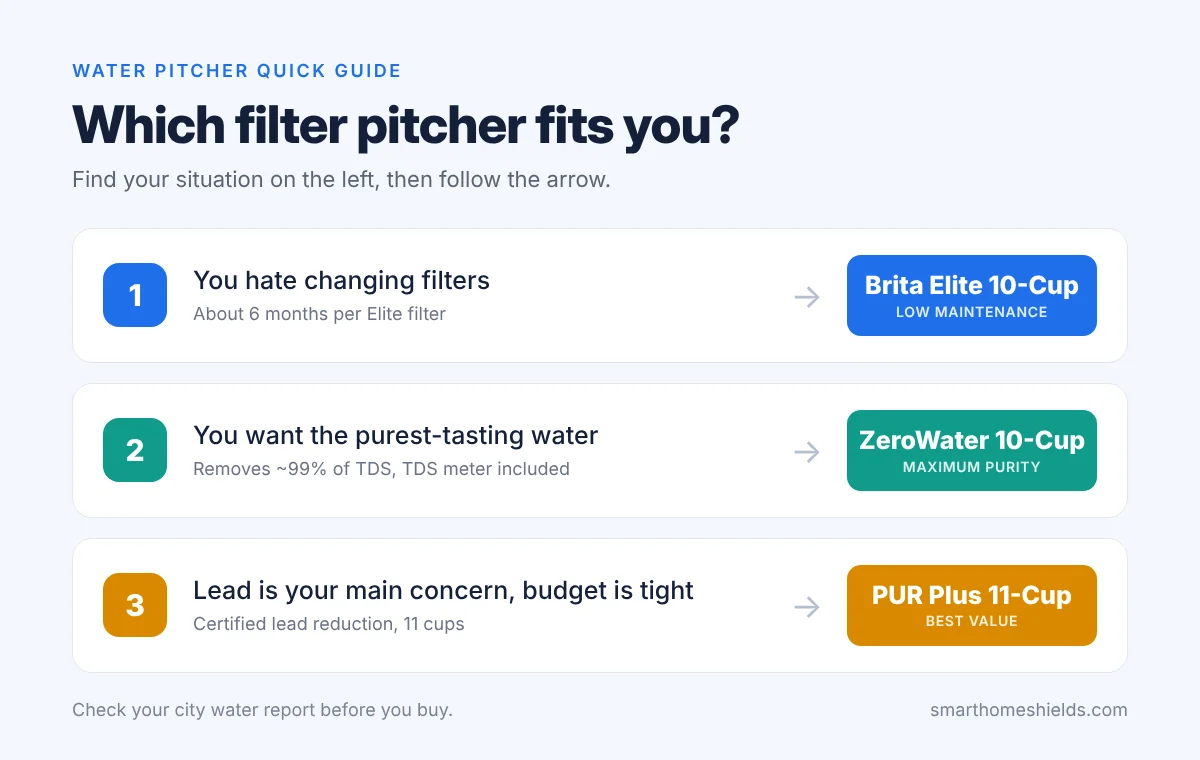
Choose Brita Elite if you hate changing filters and want low maintenance. Choose ZeroWater if you want absolute purity. Choose PUR Plus if you want strong lead reduction on a budget.
Want filtered water at every tap? Pitchers only filter what you drink. For the shower and the rest of the house, see our picks for whole-house water filters, or upgrade your drinking water to a reverse osmosis system.
FAQ
How often should I change a pitcher filter?
Follow the manufacturer’s schedule: about every 6 months for Brita Elite and every 2 months for PUR Plus. For ZeroWater, replace the filter when the included TDS meter reads 006 or higher.
Do water filter pitchers remove PFAS?
Some do. ZeroWater is certified to reduce PFOA/PFOS. Check each filter’s certification list for the specific contaminants you care about.
Why does my new filter make black specks?
Loose carbon dust is normal in new carbon filters. Soak or flush the filter as the instructions describe before first use.
Affiliate Disclosure: As an Amazon Associate, Smart Home Shields earns from qualifying purchases. Product details and availability on Amazon change often, so check the current listing before you buy.
Pingback: Best Reverse Osmosis Water Filtration Systems for Home (2026 Review) – smarthomeshields.com