Clean drinking water is essential for a healthy home, but tap water often contains chlorine, heavy metals, PFAS, and other contaminants you can’t see or taste. A reverse osmosis (RO) system is the most thorough way to filter drinking water at home: it pushes water through a membrane fine enough to remove most dissolved solids, then sends clean water to its own faucet at your kitchen sink.
In this guide, we compare three of the best RO systems for US homes in 2026 — a premium tankless model, a remineralizing system, and a proven budget pick — based on certifications, filtration capacity, installation, and long-term upkeep.
This article contains Amazon affiliate links. As an Amazon Associate, we earn from qualifying purchases, at no extra cost to you. It doesn’t affect which products we recommend.
Quick Picks
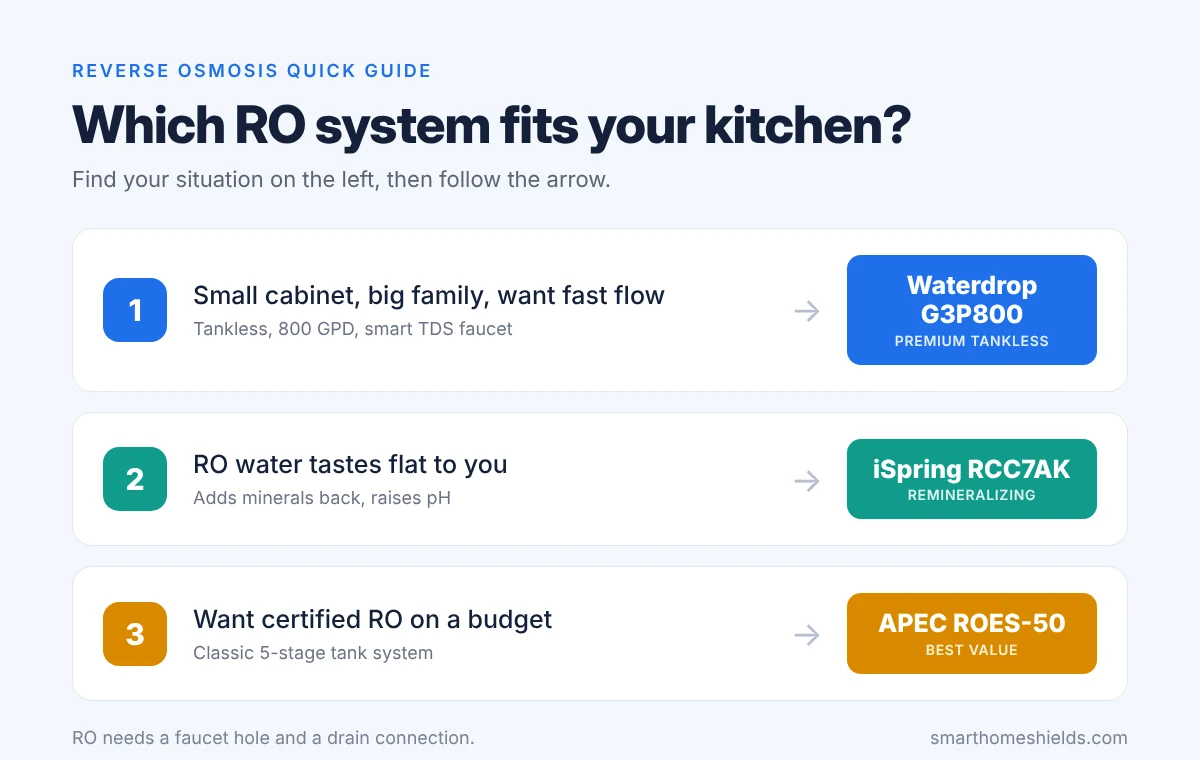
Best premium tankless system: Waterdrop G3P800
Best for remineralized (alkaline) water: iSpring RCC7AK
Best value classic system: APEC ROES-50
| System | Best For | Design | Capacity | Certification | Price |
|---|---|---|---|---|---|
| Waterdrop G3P800 | Premium, tankless | Tankless, needs power | 800 GPD | NSF/ANSI 42, 53, 58, 372 | Check price |
| iSpring RCC7AK | Remineralized water | Storage tank, 6 stages | 75 GPD | NSF/ANSI 58 (full system) | Check price |
| APEC ROES-50 | Best value | Storage tank, 5 stages | 50 GPD | NSF/ANSI 58, 372 | Check price |
GPD = gallons per day the system can produce. Certifications are as listed by each manufacturer on Amazon at the time of writing.
1. Waterdrop G3P800 — Best Premium Tankless System
The Waterdrop G3P800 is the system to get if under-sink space is tight and you want water fast. There’s no storage tank: a built-in pump pushes water through the filters on demand, at up to 800 gallons per day. That’s quick enough to fill a glass in seconds and keep up with a big family’s cooking and drinking.
It also wastes less water than older RO designs. Waterdrop rates it at a 3:1 pure-to-drain ratio, meaning about one gallon goes down the drain for every three gallons of clean water. Traditional tank systems often send several gallons to the drain for each one they produce.
Key features
- Certified to NSF/ANSI 42, 53, 58 and 372 (by IAPMO R&T) for reducing TDS, chlorine, taste and odor, and other contaminants.
- Smart faucet with an LED display that shows your water’s TDS level and filter life at a glance.
- Tankless, compact design that frees up cabinet space.
- Waterdrop says its multi-stage filtration reduces PFAS, fluoride, lead, chromium, nitrate and more, based on third-party (SGS) testing.
Pros: very fast flow with no tank to wait on; saves under-sink space; less wastewater than tank systems; real-time water quality display on the faucet.
Cons: needs an electrical outlet under the sink; installation means drilling two holes (one for the faucet, one for the drain connection); the most expensive system here; does not add minerals back.
Who it’s for: larger households, small kitchens with little cabinet space, and anyone who wants the most convenient RO setup.
2. iSpring RCC7AK — Best for Remineralized (Alkaline) Water
Reverse osmosis is so thorough that it also strips out calcium and magnesium, which leaves some people finding the water flat-tasting. The iSpring RCC7AK solves this with a sixth “AK” stage that adds minerals back after the membrane and raises the water’s pH, so it tastes closer to spring water.
It’s one of the most popular RO systems in the US, and it’s certified to NSF/ANSI 58 as a complete system, not just individual parts. iSpring lists high reduction rates for lead, fluoride, chlorine, PFAS and TDS.
Key features
- 6 stages including alkaline remineralization; produces up to 75 gallons per day into a storage tank.
- Full-system NSF/ANSI 58 certification.
- Transparent first-stage housing, so you can see when the sediment filter is getting dirty.
- Top-mounted faucet fastener that lets you install the faucet from above the counter, which is easier than working under the sink.
- Lifetime technical support from iSpring’s team in Atlanta, GA.
Pros: better-tasting, mineralized water; full-system certification; huge user base and easy-to-find replacement filters; no electricity needed.
Cons: the storage tank takes up cabinet space; slower than tankless systems when refilling a big pot; more filters to replace than a 3-cartridge tankless model.
Who it’s for: anyone who wants RO-level filtration without the “flat” taste, and buyers who value a long track record.
3. APEC ROES-50 — Best Value Classic System
The APEC ROES-50 is a no-frills, proven 5-stage RO system that has been a go-to budget pick for years. It produces up to 50 gallons per day into a storage tank, which is plenty for drinking and cooking in most homes, and it’s certified to NSF/ANSI 58 and 372.
It’s designed for DIY installation, with quick-connect fittings and color-coded tubing. Everything you need comes in the box: the filter set, a brushed nickel faucet, the storage tank, and an installation kit.
Key features
- 5-stage filtration that APEC says removes up to 99.99% of impurities, including arsenic, chlorine, lead and fluoride.
- Long-lasting filters: APEC recommends replacing them every 6 to 24 months, depending on your water.
- Complete kit with faucet, tank and installation parts.
- No electricity required.
Pros: strong value; simple, reliable design with no electronics to fail; DIY-friendly; widely available replacement filters.
Cons: lower output (50 GPD) and slower flow than tankless models; the tank takes up space; no remineralization stage.
Who it’s for: budget-conscious households that want certified RO water without paying for smart features.
Buying Guide: How to Choose the Right RO System
Tank or tankless?
Tank systems (like the iSpring and APEC) store filtered water in a pressurized tank, so they need no electricity but take up cabinet space and slow down when the tank runs low. Tankless systems (like the Waterdrop) filter on demand, save space, and waste less water, but need a power outlet under the sink.
Look for NSF/ANSI 58
NSF/ANSI 58 is the standard specifically for reverse osmosis systems. NSF/ANSI 53 covers health-related contaminants like lead, 42 covers taste and odor, and 372 confirms lead-free components. Check whether the whole system is certified or only a part of it.
Think about taste
RO removes minerals along with contaminants. If you prefer water with a bit of “body,” choose a system with a remineralization stage like the iSpring RCC7AK.
Plan the installation
Most RO systems need a dedicated faucet hole in your sink or countertop and a connection to the drain pipe. Handy homeowners can usually do it in an afternoon, but if your countertop is stone or quartz, a plumber may be worth it.
Budget for filters
Every RO system needs regular filter and membrane changes, so check the replacement schedule and filter cost before you buy, not just the system price.
Not ready to drill? A water filter pitcher is the easiest place to start, and a whole-house filter handles chlorine at every tap, including the shower.
FAQ
Does reverse osmosis remove fluoride and lead?
Yes. RO is one of the most effective home methods for reducing both. Check each system’s certifications and performance data for the exact reduction rates.
Does an RO system waste water?
All RO systems send some water down the drain to flush the membrane. Newer tankless models are more efficient: the Waterdrop G3P800 is rated at a 3:1 pure-to-drain ratio.
Is RO water healthy without minerals?
Most of the minerals in your diet come from food, not water. If you prefer the taste of mineralized water, a remineralization stage adds calcium and magnesium back.
Can I install an RO system in an apartment?
Usually, yes, if your landlord allows a dedicated faucet and drain connection. If not, a pitcher or countertop filter is the renter-friendly alternative.
Affiliate Disclosure: As an Amazon Associate, Smart Home Shields earns from qualifying purchases. Product details and availability on Amazon change often, so check the current listing before you buy.