This article contains Amazon affiliate links. As an Amazon Associate we earn from qualifying purchases. Buying through our links does not change the price you pay.
The short version
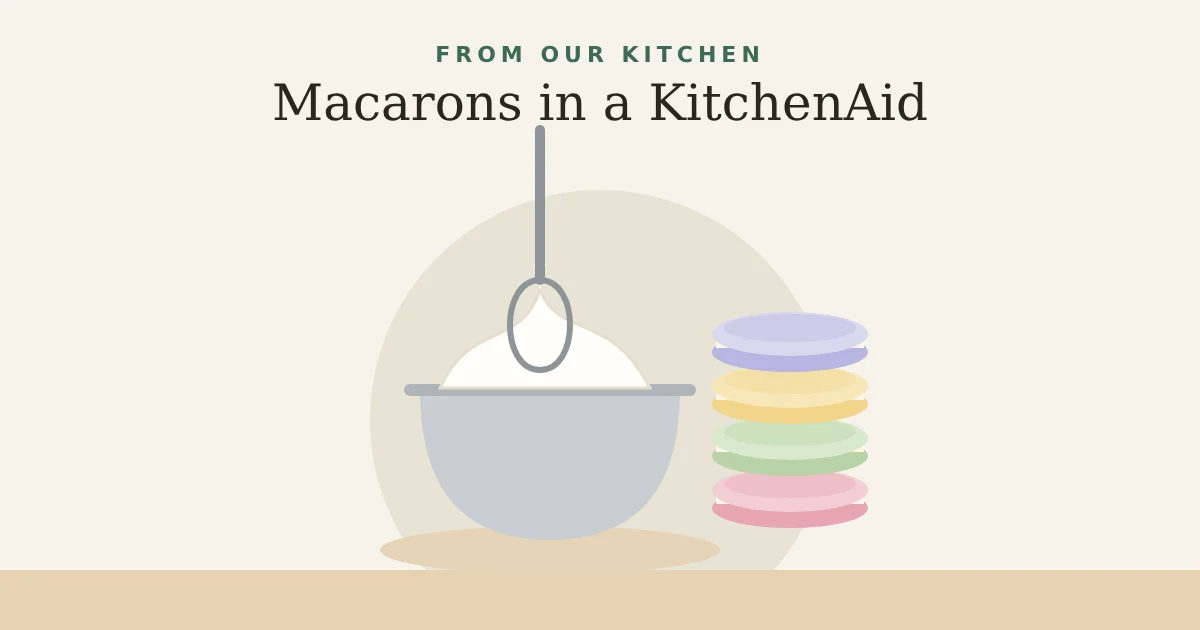
A KitchenAid stand mixer makes the hardest part of macarons, the meringue, almost hands-off: whip at speed 4 until foamy, add sugar slowly at 6, finish at 8 until the peak holds a point. Everything after that (folding, piping, resting, baking) is done by hand and by the oven. If your shells come out hollow, cracked or flat, the fix-it chart below usually points to one change.
I do most of the cooking and baking in our family, and macarons are what I bake when I want to know whether a mixer, an oven or I am having a good day. Cakes and pies forgive a lot. Macarons don't: a meringue that is a little soft, an oven that runs 15 degrees hot or ten extra strokes of the spatula and the batch tells you.
Our stand mixer is a KitchenAid, so this is the method I use with it, the speeds that work for the meringue and the small tools that make macarons more predictable. One honest note: the mixer is mine. The other tools I recommend below are picks I made from specs, warranty terms and owner reviews, and I say so on each one.
My base recipe (French method, about 20–24 filled macarons)
- 100 g egg whites (about 3 large eggs), at room temperature
- 90 g granulated sugar
- 110 g blanched almond flour, finely ground
- 110 g powdered sugar
- A pinch of cream of tartar (optional, helps the whites hold)
- Gel food color, a few drops (optional)
Weigh everything. I sift the almond flour and powdered sugar together and throw away the coarse bits left in the sieve. Three egg whites is also about the smallest batch a 5-quart bowl whips well; with less, the whip barely touches the whites.
The meringue in the KitchenAid: speed by speed
Start with a bowl and whip that are completely clean and dry. Any trace of fat or yolk keeps whites from whipping up. Attach the wire whip, not the flat beater.
- Speed 4, about a minute: whip the whites (and cream of tartar) until foamy and opaque.
- Speed 6: add the granulated sugar a spoonful at a time, letting each one mix in before the next. Rushing the sugar is the most common reason a meringue never gets stiff.
- Speed 8: whip until the meringue is thick and glossy and the peak on the whip holds a sharp point when you lift it. Add the gel color in the last 20 seconds.
- Switch off. Everything from here happens with a spatula.
These speeds follow KitchenAid's own speed guide, which uses speed 4 for adding sugar to egg whites, 6 for whipping them and 8 for stiff whites. I don't go to 10: on a small batch it is easy to overshoot and get a dry, grainy meringue.
Folding, piping, resting and baking
Fold (macaronage). Add the sifted almond flour and powdered sugar in two parts and fold, pressing the batter against the side of the bowl. It is ready when it falls off the spatula in a thick ribbon that sinks back into the surface in about 10 seconds. Under-folded batter keeps peaks; over-folded batter spreads.
Pipe. Hold the bag straight up over the center of each circle, squeeze, stop, flick away. Then bang the tray on the counter a few times to release air bubbles and pop any left with a toothpick.
Rest. Leave the shells until the tops are dry to the touch and no longer sticky, usually 30 to 60 minutes. On humid days it takes longer.
Bake. Around 300°F (150°C) on the middle rack, one tray at a time, for about 15 to 18 minutes. Check with an oven thermometer, not the dial: this is where most batches are won or lost. They are done when the shells don't wobble on their feet if you nudge one.
Fill and wait. Let them cool completely before lifting them off. After filling, a night in an airtight box in the fridge makes them softer and better.
Quick note from Milena: ovens are different. Treat the temperature and time as a starting point, and change one thing per batch so you know what helped.
Macaron fix-it chart
Look at your shells, find the problem, change one thing next time.
| What you see | Most likely cause | What to change next batch |
|---|---|---|
| Hollow shells (air gap under the top) | Meringue under-whipped, oven too hot, or shells under-baked | Whip until the peak holds a sharp point; check the oven with a thermometer; add 1–2 minutes of baking |
| Cracked tops | No skin before baking, big air bubbles, or heat too strong | Tap the tray firmly after piping, pop bubbles with a toothpick, rest until the top is dry to the touch |
| No feet | Batter over-folded, shells not rested, or oven too cool | Stop folding as soon as the batter flows like slow lava; rest longer; confirm the temperature |
| Lopsided feet | Uneven oven heat or a warped tray | Rotate the tray halfway; bake one tray at a time on the middle rack; use a flat, heavy tray |
| Spread into flat discs | Over-folded batter or watery color | Fold fewer strokes; use gel color, not liquid |
| Bumpy, grainy tops | Coarse almond flour or lumps | Sift the almond flour and powdered sugar together; discard the coarse bits |
| Stuck to the mat | Under-baked | Bake a little longer and let them cool completely before lifting |
The 7 tools that make macarons easier
You don't need a pastry shop's worth of gear. You need accurate weights, a true oven temperature, even circles and a strong meringue. These are my picks for each job.
Shopping on Black Friday? Add it to your Amazon cart now so it is ready when deals start.
KitchenAid Artisan 5-Qt Tilt-Head Stand Mixer
This is the mixer I use.
Why it helps: The wire whip reaches the whole bowl, and ten speeds give you the slow-fast-faster steps a meringue needs. It also does every cake batter and pie crust I make.
What owners complain about: noise at high speed, the head rocking a little with very stiff dough, and the beater-to-bowl gap needing a small adjustment out of the box (KitchenAid explains how in the manual).
Skip it if you only bake a few times a year; a hand mixer can whip a meringue, it just takes longer and your arm does the work.
Read our full KitchenAid Artisan review or Artisan vs Classic.
Etekcity Digital Kitchen Scale (11 lb, grams)
I haven't owned this exact model; it's my pick from specs and owner reviews.
Why it helps: Macarons are a ratio recipe. Cups and spoons are not accurate enough for egg whites and almond flour. This scale reads in 1 g steps, has a tare button and is one of the best-selling kitchen scales on Amazon.
What owners complain about: the auto-off timer kicking in while you add sugar slowly, and fingerprints on the stainless top.
Skip it if you already have a scale that reads in grams.
Rubbermaid Commercial Oven Thermometer
I haven't owned this one; my pick is based on specs and owner reviews.
Why it helps: Home ovens often run hotter or cooler than the dial says, and macarons notice a difference that a casserole never would. This one needs no batteries and reads from 60°F to 580°F.
What owners complain about: the small dial being hard to read through the oven door, and occasional units that read a little off, so compare it with a second thermometer if results look strange.
Skip it if you already know your oven's real temperature.
Amazon Basics Silicone Baking Mat for Macarons (2-pack)
I haven't used this exact mat; it's my pick from specs and owner reviews.
Why it helps: The printed template (30 halves per sheet) makes equal sizes easy, which matters because shells are baked in pairs. The listing says oven-safe up to 480°F and dishwasher safe.
What owners complain about: the circles not matching the size some recipes want, and the mat needing a flat, sturdy tray under it. Some bakers get flatter feet on parchment and keep the mat as a piping guide.
Skip it if you already pipe even circles on parchment with a printed template underneath.
Riccle Piping Bags and Tips Set (100 bags, 16 tips)
I haven't used this set; it's my pick from specs and owner reviews.
Why it helps: Disposable bags mean no washing almond batter out of fabric, and the kit covers frosting and fillings too. One of the best-selling decorating kits on Amazon.
What owners complain about: the 11.8-inch bags being small for a full batch (you refill once or twice) and the tips not being labeled. For shells you want a plain round opening around 3/8 to 1/2 inch.
Skip it if you already have a large plain round tip and reusable bags.
AmeriColor Soft Gel Paste Student Kit (12 colors)
I haven't used this kit; it's my pick from specs and owner reviews.
Why it helps: Gel colors are concentrated, so a few drops color the meringue without adding the extra liquid that makes batter spread. The squeeze bottles make it easy to add a drop at a time.
What owners complain about: stained fingers and counters, and bottle tips that clog if you don't wipe them.
Skip it if you plan to keep your shells natural, which is a classic look too.
Blue Diamond Almond Flour, blanched, finely sifted (3 lb)
I haven't compared almond flour brands side by side; this is my pick from specs and owner reviews.
Why it helps: Macarons need blanched almond flour (no skins) that is ground fine. Blue Diamond's is blanched and finely sifted, and the 3-pound bag covers many batches.
What owners complain about: a few clumps in the bag (sift it anyway) and the big bag going stale if left open; store it airtight in the fridge or freezer.
Skip it if you buy almond flour locally or bake macarons once a year; a smaller bag is enough.
Macaron day checklist
- Egg whites out of the fridge an hour ahead
- Bowl and whip washed and dried; no yolk in the whites
- Almond flour and powdered sugar weighed and sifted together
- Oven on with a thermometer inside, at least 20 minutes before baking
- Piping bag ready in a tall glass, tip in place
- Mat or parchment on a flat, heavy tray
- Timer set for resting and baking
FAQ
What speed do you whip macaron meringue on a KitchenAid?
KitchenAid's speed guide puts egg whites on the wire whip at speed 4 to add sugar, speed 6 for medium-fast whipping and speed 8 for stiff whites. I start at 4 until foamy, add the sugar slowly at 6, then finish at 8 until the peak holds a point.
Can you make macarons with a hand mixer?
Yes. A hand mixer can whip the meringue; it takes longer and you need to move it around the bowl. The folding is done by hand either way.
Why are my macarons hollow?
The usual causes are an under-whipped meringue, an oven that runs hot, or shells that came out a little early. An oven thermometer and a stiffer meringue fix most hollow shells.
Why didn't my macarons get feet?
Over-folded batter, shells that were not rested until dry to the touch, or an oven that is too cool. Fold just until the batter flows slowly off the spatula and let the piped shells rest.
Silicone mat or parchment for macarons?
Both work. A printed silicone mat makes even circles easy; some bakers get flatter feet on parchment. Whichever you use, bake on a flat, heavy tray.
How long do macarons keep?
Filled macarons are usually best after a night in an airtight box in the fridge, which softens the shells. Take them out a little before serving. Unfilled shells freeze well in an airtight container.
More from our kitchen
- KitchenAid Artisan 5-Qt stand mixer review
- KitchenAid Artisan vs Classic
- Breville Smart Oven Air Fryer Pro review
- Best meat thermometers for Thanksgiving
- Budget smart home gifts
Sources
- KitchenAid: Stand mixer speed control guide
- Product listings and specifications on Amazon.com, checked October 16, 2026
From our kitchen: Instant Pot Duo vs Ninja HyperHeat: which pressure cooker to buy.
Affiliate disclosure: Smart Home Shields is a participant in the Amazon Services LLC Associates Program. As an Amazon Associate I earn from qualifying purchases. Product details and availability on Amazon change often, so check the current listing before you buy.