This comparison contains Amazon affiliate links. As an Amazon Associate I earn from qualifying purchases, at no extra cost to you.
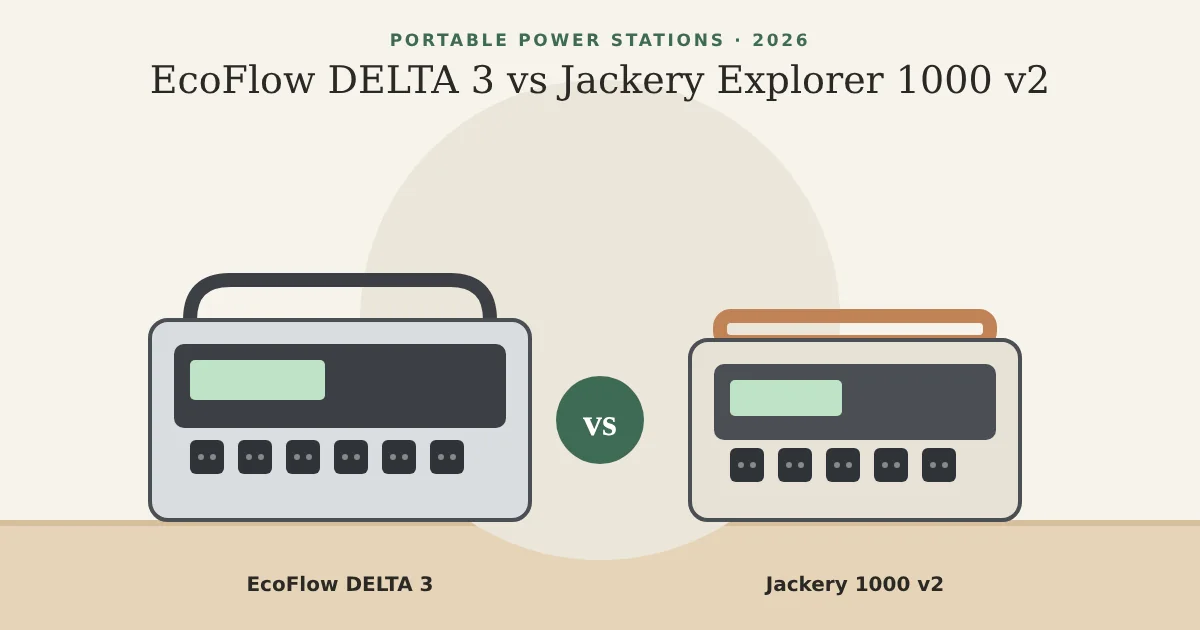
EcoFlow and Jackery are the two biggest names in portable power stations, and their 1 kWh models are among the best sellers on Amazon. The EcoFlow DELTA 3 and the Jackery Explorer 1000 v2 store almost the same amount of energy and both use long-life LiFePO4 batteries, but they are built for different jobs.
In short: the EcoFlow is the stronger home-backup machine, and the Jackery is the lighter, simpler travel companion. Here is the full comparison.
Quick Answer
- Choose the EcoFlow DELTA 3 if you mainly want backup power at home: more AC output, 13 outlets, 500 W solar input and the option to expand to 5 kWh later.
- Choose the Jackery Explorer 1000 v2 if you want something lighter and more compact for camping, road trips and occasional outages, and you do not need to expand capacity.
Check EcoFlow DELTA 3 on Amazon Check Jackery 1000 v2 on Amazon
Side-by-Side Comparison
| Feature | EcoFlow DELTA 3 | Jackery Explorer 1000 v2 |
|---|---|---|
| Capacity | 1,024 Wh | 1,070 Wh |
| Battery | LiFePO4, 4,000 cycles to 80% | LiFePO4, 4,000 cycles to 70%+ |
| AC output | 1,800 W (3,600 W surge) | 1,500 W (3,000 W surge) |
| Boost mode | X-Boost runs some resistive appliances above the rated output | No |
| Outlets | 13 in total | 7 in total: 3 AC, 2 USB-C (100 W and 30 W), 1 USB-A, 1 car port |
| Fast charging | Up to 1,500 W AC input; full charge in about 56 minutes when combined with solar, 80% in about 30 minutes | About 1 hour in emergency mode (set in the app); about 1.7 hours by default |
| Solar input | Up to 500 W | Up to 400 W, Jackery panels only |
| Expandable | Yes, up to 5 kWh with extra batteries | No |
| Weight | 27.5 lb | 23.8 lb |
| Size | 15.7 x 8 x 11.2 in | 12.9 x 8.8 x 9.7 in |
| Warranty | 5 years | 3 years + 2-year extension |
From the Amazon listings and the manufacturers' websites, checked October 2026. Prices change often, so we do not list them here.
Power Output: EcoFlow Runs Bigger Appliances
The DELTA 3 delivers 1,800 W continuously with a 3,600 W surge, against 1,500 W and 3,000 W for the Jackery. That extra headroom matters for things like a microwave, a space heater or a power tool. EcoFlow's X-Boost mode can also run some heating appliances rated above 1,800 W by lowering their power slightly, so they work, just a little slower.
The EcoFlow also has far more outlets: 13 in total, compared with 7 on the Jackery (3 AC, 2 USB-C, 1 USB-A and a car port). If you want to keep a fridge, a router, lights and phones running at the same time, the EcoFlow is easier to live with.
Capacity and Battery Life: Nearly Identical
The Jackery stores slightly more energy, 1,070 Wh versus 1,024 Wh, a difference you will barely notice. Both use LiFePO4 cells rated for 4,000 charge cycles, which is more than ten years of regular use. EcoFlow rates its cells to 80% capacity after 4,000 cycles, and Jackery to over 70%.
Charging Speed and Solar
Both are fast chargers. The DELTA 3 accepts up to 1,500 W from a wall outlet, and EcoFlow says it reaches 80% in about 30 minutes and a full charge in about 56 minutes when AC and 500 W of solar are combined. The Jackery can do a full charge in about 1 hour, but only in emergency mode, which you switch on in the Jackery app each time; by default it charges more gently in about 1.7 hours to protect the battery.
For solar, the EcoFlow accepts up to 500 W and the Jackery up to 400 W. Jackery also says the Explorer 1000 v2 works only with Jackery solar panels, so you are tied to its own panels. If you plan to build a solar setup, the EcoFlow is more flexible.
Size and Weight: Jackery Is Easier to Carry
At 23.8 lb and about 12.9 x 8.8 x 9.7 inches, the Jackery is almost 4 pounds lighter and noticeably more compact than the 27.5 lb EcoFlow. It also has a foldable handle. If you will move it in and out of a car regularly, that difference adds up.
Expandability: Only EcoFlow Can Grow
The DELTA 3 can connect to EcoFlow extra batteries for up to 5 kWh in total, which can keep essentials running through a long outage. The Explorer 1000 v2 has no add-on battery option; if you need more capacity later, you buy a bigger station.
Warranty
EcoFlow covers the DELTA 3 for 5 years. Jackery offers 3 years standard plus a 2-year extension, also 5 years in total, so warranty is not a deciding factor.
How much capacity do you need? Add up the watts of what you want to run and how many hours. A 1 kWh station can run a 100 W fridge for several hours or charge a phone dozens of times, but it will not power a whole house. For multi-day outages, look at expandable systems like the DELTA 3 with an extra battery.
Who Should Skip Each One
- Skip the EcoFlow DELTA 3 if weight and size matter most, for example if you carry it to campsites often.
- Skip the Jackery Explorer 1000 v2 if you need many outlets, want to use other brands of solar panels, or may want more capacity later.
Our Verdict
For home backup, the EcoFlow DELTA 3 is the better buy: more output, more outlets, more solar input and room to expand. For camping, road trips and light emergency use, the Jackery Explorer 1000 v2 is lighter, more compact and slightly larger in capacity, which makes it the easier station to take with you.
More home tech guides: browse all reviews or see the ecobee Smart Thermostat Premium review.
How we compare: we have not lab-tested these power stations ourselves. This comparison is based on manufacturer specifications, the Amazon listings and recurring themes in buyer reviews.
FAQ
Which is better for home backup during a power outage?
The EcoFlow DELTA 3. It has more AC output, more outlets, more solar input and can be expanded to 5 kWh with extra batteries, which matters during long outages.
Which is better for camping and road trips?
The Jackery Explorer 1000 v2. It is almost 4 pounds lighter and noticeably smaller, while offering slightly more battery capacity.
Can either one run a refrigerator?
Yes. Both have enough output for a typical home refrigerator. How long it runs depends on the fridge, but a 1 kWh station usually keeps an efficient fridge going for several hours, not days.
Can I use other brands of solar panels?
With the EcoFlow DELTA 3, solar panels within its input range generally work. Jackery says the Explorer 1000 v2 works only with Jackery solar panels.
Which one charges faster?
Both are fast. EcoFlow quotes a full charge in about 56 minutes when combining up to 1,500 W of AC input with solar. The Jackery reaches a full charge from the wall in about 1 hour in emergency mode, which you turn on in its app; by default it takes about 1.7 hours to protect battery health.
Affiliate Disclosure: As an Amazon Associate, I earn from qualifying purchases. This means if you click on a link and make a purchase, I may receive a small commission at no extra cost to you. Product details on Amazon change often, so check the current listing before you buy.