
This guide contains Amazon affiliate links. As an Amazon Associate we earn from qualifying purchases, at no extra cost to you.
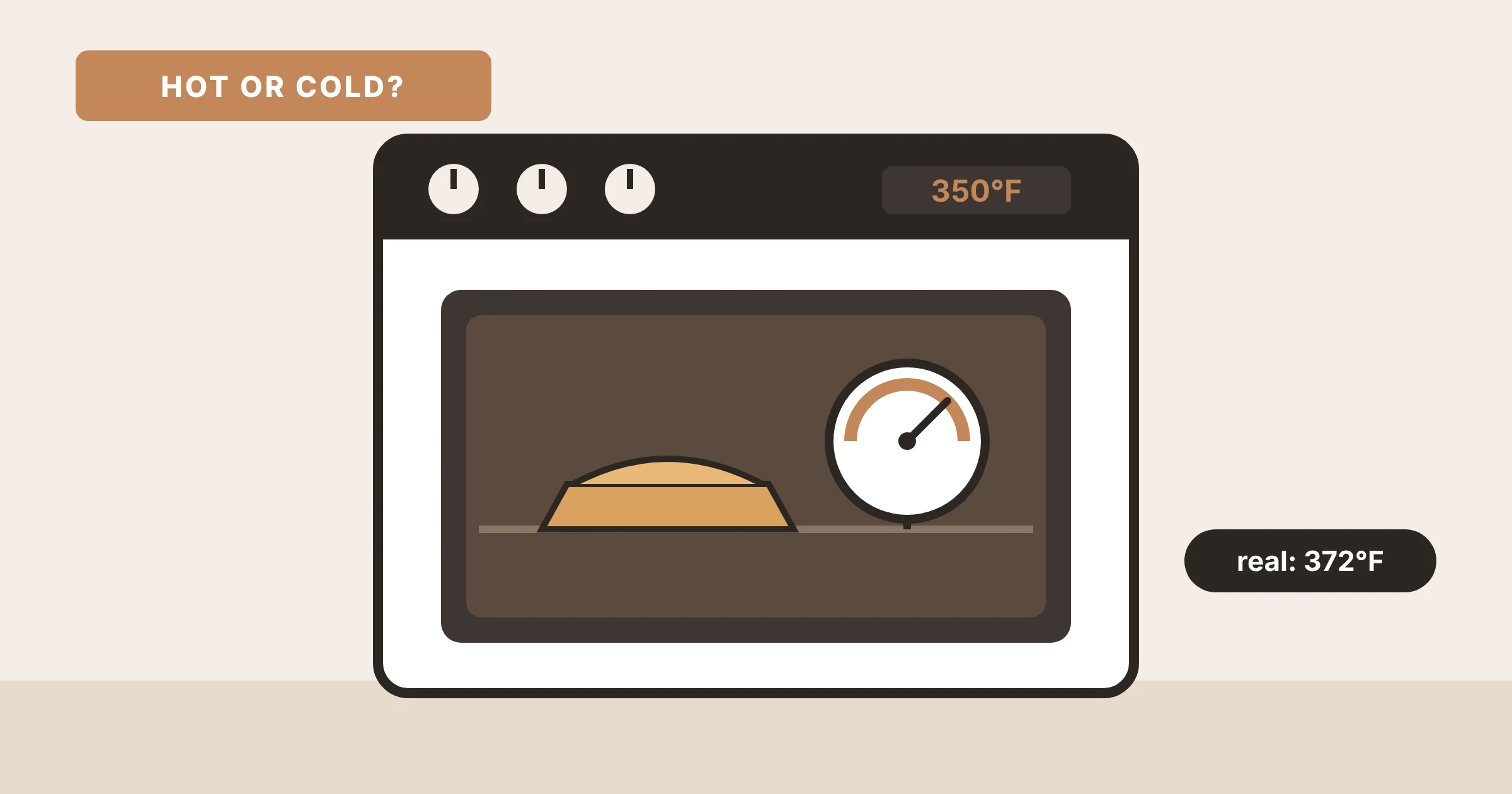
We bake a lot at home: macarons, cakes, pies. Macarons are the ones that taught me how much a few degrees matter. They’re fussy about heat, and a recipe that works in one oven can come out cracked or browned in another. Before the holidays, when the oven runs all day and every pie counts, it’s worth spending 40 minutes finding out what your oven really does when you set it to 350.
Below is the test, a calculator for the numbers, and what to do if your oven is off. I haven’t lab-tested oven thermometers; the advice on testing comes from America’s Test Kitchen and appliance repair guides, linked at the end.
Signs your oven is off
- Recipes take noticeably longer or shorter than the time given, every time.
- Pie crusts and cookie edges brown before the middle is done (too hot).
- Cakes sink or stay pale and gummy (too cool).
- One side of the tray always browns more: that’s a hot spot, not calibration.
- You moved, or got a new oven, and your usual recipes stopped working.
The 40-minute oven test
- Empty the oven and put one rack in the center position.
- Place the thermometer in the middle of the center rack, or hang a dial one from the rack slightly above center, facing the door glass so you can read it without opening the door.
- Set 350°F, or the temperature where your baking goes wrong.
- Wait about 30 minutes for a digital probe thermometer, at least 40 for a dial.
- Watch for 10 minutes and write down the highest and lowest readings. Open the door as little as possible: each opening drops the temperature.
- Average them. That’s your oven’s real temperature. Enter the numbers below.
Why not trust the oven’s display? Its sensor sits at one spot, usually off to the side, so it measures the air there, not where your pie is. And the swing is normal: America’s Test Kitchen says even a well-calibrated oven can swing as much as 25 degrees above and below the target while averaging out correctly.
Oven offset calculator
What is your oven really doing?
How to fix it
Digital ovens: use the offset setting
Most ovens with an electronic control let you shift the temperature up or down, usually by up to about 30 to 35 degrees. It’s often in the settings menu, or under a button held for a few seconds (on many Whirlpool and GE models it’s a combination of the Bake button and the arrows). Your manual has the exact steps; search the model number on the label inside the door if you’ve lost it. After adjusting, run the test again.
Older dial ovens
Some have a small adjustment screw behind the temperature knob. If yours doesn’t, or you’d rather not, just set the dial by the calculator’s number and leave the thermometer in the oven.
When it’s a repair
If the oven is off by more than the offset allows, if the temperature keeps climbing, or if it never reaches temperature, the sensor or igniter may be failing. Repair guides list the temperature sensor, the igniter on gas ovens and the bake element on electric ones as the usual suspects. That’s a job for a technician, and worth booking well before Thanksgiving week.
Which thermometer to use
You don’t need anything expensive for this. Two types work:
Dial oven thermometer (stainless steel)
Hangs from or stands on the rack and stays in the oven, so you can glance through the door glass anytime. Slower to settle than a digital probe, which is why the test needs 40 minutes. Look for a large, easy-to-read dial and a range that covers your hottest baking.
Pros: very cheap; no batteries; lives in the oven.
Cons: slow to react; small dials are hard to read through the glass.
Digital probe thermometer with an oven clip
A wired probe clipped to the center rack, with the display outside the oven. It reacts faster and shows the swings clearly. Many double as a meat thermometer for the turkey, so one gadget covers both jobs.
Pros: faster, easier to read; doubles for meat.
Cons: needs batteries; the cable must not get pinched in the door hinge.
Roasting the turkey too? Our comparison of Meater vs ThermoPro TempSpike vs Chef iQ covers wireless meat probes, and for the baking side, hand mixer vs stand mixer for holiday baking helps you decide what else you need.
Holiday baking tips once you know your oven
- Preheat longer than the beep. Many ovens beep before the walls are fully hot. Give it another 10 to 15 minutes before a pie goes in.
- Rotate trays halfway if one side browns faster.
- Keep the thermometer in during the holidays. With the oven full and the door opening a lot, it tells you when to wait.
- Don’t crowd the oven: two big dishes block the airflow and everything bakes slower.
FAQ
How do I know if my oven temperature is accurate?
Hang an oven thermometer in the middle of the center rack, set the oven to 350°F and wait at least 30 to 40 minutes. Note the highest and lowest readings over about 10 minutes and average them. If the average is within about 10 to 15 degrees of the setting, your oven is fine.
Is it normal for an oven to go up and down in temperature?
Yes. Ovens cycle the heat on and off, so the temperature swings around the target. America's Test Kitchen notes a well-calibrated oven can swing as much as 25 degrees above and below the target while still averaging correctly.
Can I recalibrate my oven myself?
Most digital ovens have a temperature offset setting in the menu or under a button combination, usually adjustable by about 30 to 35 degrees. Older dial ovens may have an adjustment screw behind the knob. Your manual shows how; if the oven is off by more than the setting allows, call for service.
Where should I put an oven thermometer?
In the middle of the center rack, or hanging from a rack slightly above center, away from the walls. The oven's own sensor sits off to the side, so it doesn't see what your food sees.
Do I need an oven thermometer if I have a meat thermometer?
They do different jobs. A meat thermometer tells you when the turkey is done; an oven thermometer tells you whether 350°F on the dial is really 350°F, which matters most for baking.
Sources
- Cook's Illustrated: Finding a good oven thermometer (temperature swings and placement)
- Reliable Parts: Why is my oven temperature not accurate? Causes and fixes
- Hunker: How to calibrate oven temperature on Whirlpool ovens
Affiliate disclosure: Smart Home Shields is a participant in the Amazon Services LLC Associates Program. As an Amazon Associate we earn from qualifying purchases. If you buy through our links, we may earn a small commission at no extra cost to you. Product details on Amazon change often, so check the current listing before you buy.